Introduction to statistics and probability
- 1 Statistics vs. probability
- 2 Inductive vs. deductive reasoning
- 3 What is the probability of a coin landing on heads?
- 4 Dice questions
- 5 Bayes’ theorem
- 6 Failing in math and/or science
- 7 Uncertainty
- 8 Epistemic vs. aleatory uncertainty
- 9 Probability distribution
- 10 Central limit theorem demo
- 11 Statistics
- 12 Reading materials
1 Statistics vs. probability
Statistics involves the frequency analysis of past events and “enables us to measure the extent to which our world is ideal” (Skiena 2001).
Probability deals with the likelihood of future events and “enables us to find the consequences of a given ideal world” (Skiena 2001).
2 Inductive vs. deductive reasoning
Inductive reasoning starts with observations and analyzes data to formulate a theory.
Deductive reasoning starts with ideas or premises and observes data to make a conclusion.
3 What is the probability of a coin landing on heads?
Do you know this probability in advance without any experiments?
Do you have to throw a coin a lot of times to observe what happens?
4 Dice questions
- What is the probability of a die rolling a 1?
- What about a 1 and then a 6 in a sequence?
- A 1 and a 6 from two dice simultaneously?
5 Bayes’ theorem
\[P(A|B) = \frac{P(A\cap B)}{P(B)} = \frac{P(B|A)P(A)}{P(B)}\]
6 Failing in math and/or science
Probability of failing in math: $P(M)=0.3$
Probability of failing in science: $P(S)=0.2$
Are these two events related or independent?
Probability of failing in both math and science: $P(M\cap S)=0.1$
What is the probability of failing in either math or science $P(M\cup S)$?
What is the probability of failing in science when you learned that you failed in math $P(S|M)$?
7 Uncertainty
We have to embrace uncertainty when studying science because we only have limited knowledge.
The lack of certainty or confidence is called uncertainty.
8 Epistemic vs. aleatory uncertainty
Epistemic uncertainty arises because of the lack of our knowledge.
Aleatory uncertainty arises because of randomness.
9 Probability distribution
A probability distribution represents the frequency or probability of occurrence of different values of a random variable.
A random variable is described by its probability distribution.
Statisticians and probabilists love normal distributions thanks to the central limit theorem.
\[f(x)=\frac{1}{\sigma\sqrt{2\pi}}e^{-\frac{1}{2}\left(\frac{x-\mu}{\sigma}\right)^2}\] where
- $x$ is a random variable,
- $\mu$ is the mean or expected value of $x$, and
- $\sigma$ is the standard deviation.
10 Central limit theorem demo
# R code by Huidae Cho
samples <- c()
sample_means <- c()
for(i in 1:1000){
  sample <- runif(100)                          # take 100 random values from a uniform distribution
  samples <- c(samples, sample)                 # collect samples
  sample_means <- c(sample_means, mean(sample)) # collect sample means
}
par(mfcol=c(2,1))
hist(samples)                                   # plot the histogram of samples
hist(sample_means)                              # plot the histogram of sample means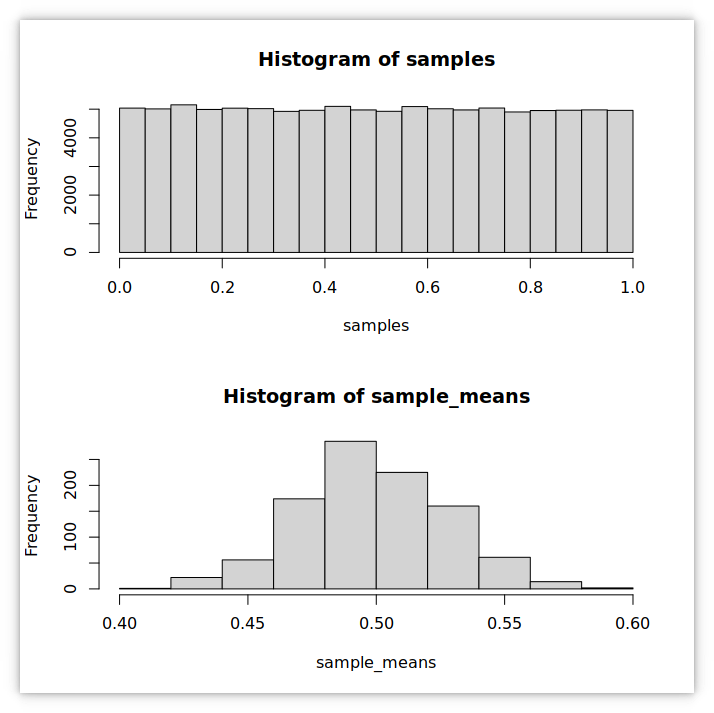
11 Statistics
Descriptive statistics is used to describe data. Examples?
- Mean $\mu=\frac{\sum_{i=1}^n x_i}{n}$
- Variance $\sigma^2=\frac{\sum_{i=1}^n(x_i-\mu)^2}{n}$
Inferential statistics is used to make predictions. Examples?
- Hypothesis tests
- Regression analysis
12 Reading materials
- Probability
- Probability versus Statistics
- Probability vs Statistics
- What’s the difference between probability and statistics?
- The Difference Between Deductive and Inductive Reasoning
- Deductive Reasoning vs. Inductive Reasoning
- Can you say that statistics and probability is like induction and deduction?
- Bayes’ theorem
- Statistical concepts in environmental science
- Descriptive statistics
- Statistical inference
- Normal distribution
- Central limit theorem
- Standard Deviation and Variance